

The Ultimate Guide to Second Passports and Global Residency Options in 2026
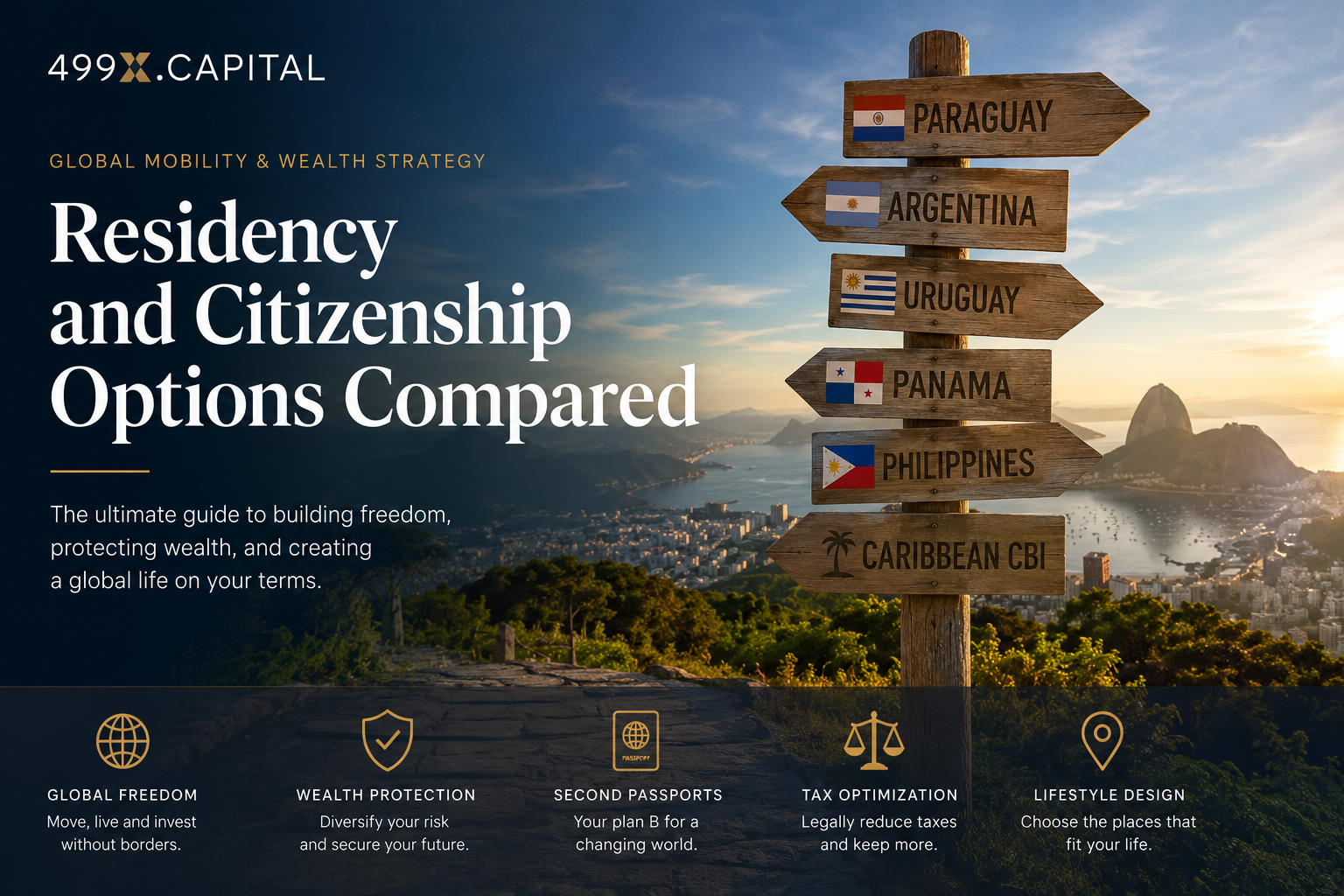
A Deep Dive Into Paraguay, Argentina, Uruguay, Panama, the Philippines, and Caribbean Citizenship-by-Investment Programs
by Dr. Christoph Lymbersky
For decades, the idea of obtaining a second passport was associated almost exclusively with billionaires, diplomats, celebrities, or politically exposed individuals. Most people viewed the concept as exotic, unnecessary, or unrealistic.
That perception has changed dramatically.
In today’s world, international diversification is no longer only about investment portfolios, real estate holdings, or offshore companies. Increasingly, entrepreneurs, investors, remote business owners, digital nomads, and globally minded families are diversifying something far more personal:
Their residency.
Their citizenship.
Their long-term freedom of movement.
Over the last several years, global events have accelerated this trend. Political instability, changing tax laws, inflation, travel restrictions, banking regulations, and geopolitical tensions have caused many people to rethink the risks of being fully dependent on a single country.
At the same time, technology and remote work have made it easier than ever to live internationally.
A growing number of entrepreneurs now operate businesses that are not tied to any single location. Investors increasingly hold global assets. Families seek educational and lifestyle opportunities beyond their home country. Wealthy individuals are looking for legal ways to create optionality and flexibility for future generations.
This is where second residency and second citizenship strategies enter the picture.
But despite the growing popularity of the topic, there is still enormous confusion surrounding how these programs actually work.
The internet is full of misleading marketing.
YouTube channels promise “easy passports in 90 days.” Influencers claim you can spend one week per year in a country and automatically receive citizenship. Immigration agencies advertise “guaranteed” outcomes that are far more complicated in reality.
The truth is more nuanced.
Some countries genuinely offer relatively accessible paths to long-term residency and eventual citizenship.
Others are excellent for tax planning or lifestyle purposes but poor choices for naturalization.
And some programs are little more than expensive residency schemes with no realistic path to a second passport.
This guide explores the real-world realities of the most discussed international residency and citizenship options in 2026.
We will examine:
- Paraguay
- Argentina
- Uruguay
- Panama
- The Philippines
- Caribbean Citizenship-by-Investment Programs
We will compare:
- costs,
- timelines,
- physical presence requirements,
- tax implications,
- legal certainty,
- banking considerations,
- quality of life,
- and the practical likelihood of actually obtaining citizenship.
Most importantly, this article separates marketing narratives from practical reality.
Why Second Passports Matter More Than Ever
The global mobility industry has evolved rapidly over the last decade.
Historically, most people pursued second citizenship for visa-free travel. Citizens from countries with weak passports sought greater international mobility through naturalization or investment programs.
Today, however, the motivations are much broader.
For many entrepreneurs and investors, a second passport is not primarily about travel convenience.
It is about sovereignty.
It is about reducing dependency on a single government.
It is about building legal and geographic flexibility in a rapidly changing world.
Increasingly, individuals pursue second residency or citizenship for five primary reasons.
1. Geopolitical Diversification
Modern history has repeatedly demonstrated how quickly governments can change.
Tax laws shift.
Capital controls emerge.
Banking systems tighten.
The implications of Global Residency extend beyond mere travel and can influence aspects of taxation and lifestyle.
Travel restrictions appear.
Political environments become unstable.
A second residency or citizenship creates optionality.
It provides individuals and families with legal alternatives should conditions in their home jurisdiction change unfavorably.
This concept has become especially important for entrepreneurs and investors with globally diversified assets.
2. Tax Optimization
One of the biggest misconceptions about second citizenship is that citizenship and tax residency are the same thing.
In reality, they are entirely separate legal concepts.
Sophisticated international entrepreneurs often separate:
- citizenship,
- tax residency,
- business operations,
- banking,
- and lifestyle.
For example:
- an entrepreneur may hold German citizenship,
- maintain tax residency in the UAE,
- operate businesses through international structures,
- bank in Switzerland,
- and hold long-term residency in Paraguay.
This multi-jurisdictional approach has become increasingly common among internationally mobile individuals.
3. Family Security and Future Planning
Many globally minded families seek second residency or citizenship for their children.
Educational opportunities, healthcare systems, political stability, and future mobility are major factors.
A second passport can create intergenerational optionality.
4. Banking and Financial Access
Certain jurisdictions provide better access to international banking, investment platforms, and global financial infrastructure.
Understanding Global Residency is crucial for making informed decisions in today’s interconnected world.
International entrepreneurs increasingly recognize the importance of geographic diversification in financial planning.
5. Lifestyle Freedom
Remote work and digital entrepreneurship have fundamentally changed the relationship between work and geography.
Millions of people are no longer tied to a single office or country.
As a result, residency decisions are increasingly driven by:
- climate,
- lifestyle,
- tax environment,
- safety,
- education,
- and overall quality of life.
The Two Main Categories of Second Passport Strategies
Broadly speaking, there are two primary approaches to obtaining a second passport.
Understanding the difference is essential.
Residency Leading to Citizenship
This is the traditional naturalization route.
An individual:
- obtains legal residency,
- lives in the country for a required period,
- integrates into society,
- and eventually applies for citizenship.
Countries such as Paraguay, Argentina, and Uruguay operate under this model.
Advantages:
- lower costs,
- more legitimate integration,
- potentially stronger passports,
- often viewed more favorably by banks and governments.
Disadvantages:
- slower,
- requires effort and planning,
- may involve physical presence requirements,
- and outcomes are not always guaranteed.
Citizenship-by-Investment
Citizenship-by-Investment programs bypass the traditional residency process.
Applicants typically make:
- government donations,
- approved investments,
- or real estate purchases.
In return, they receive citizenship directly.
The Caribbean dominates this market.
Advantages:
- speed,
- predictability,
- minimal relocation requirements,
- fast family inclusion.
Disadvantages:
- expensive,
- increasing international scrutiny,
- and sometimes weaker international perception.
Paraguay: The Ultimate Low-Presence Residency Jurisdiction
Paraguay is one of the most overlooked countries in the global mobility world.
Located in the heart of South America, the country is rarely discussed in mainstream international media and remains largely outside the attention of mass tourism and global finance. Yet among internationally mobile entrepreneurs, tax strategists, and long-term residency planners, Paraguay has quietly developed a reputation as one of the most attractive backup residency jurisdictions in the world.
What makes Paraguay unique is not luxury, prestige, or infrastructure.
What makes it special is flexibility.
The country offers a rare combination of:
- low costs,
- relatively simple immigration,
- favorable taxation,
- political neutrality,
- and extremely low physical presence requirements.
Unlike many Western jurisdictions that increasingly demand substance, reporting, and full-time residence, Paraguay still offers a degree of freedom and optionality that has largely disappeared elsewhere.
For globally mobile entrepreneurs who value flexibility more than status, Paraguay has become one of the most interesting jurisdictions worldwide.
Among all international residency jurisdictions, Paraguay has become one of the most discussed and misunderstood.
Over the past several years, the country has attracted enormous attention from:
- entrepreneurs,
- digital nomads,
- investors,
- remote business owners,
- and internationally mobile families.
The reason is simple.
Paraguay offers one of the rarest combinations in global mobility:
- low cost,
- relatively simple residency,
- favorable taxation,
- and extremely low physical presence requirements.
Why Paraguay Became Popular
Unlike many Western jurisdictions, Paraguay historically maintained relatively accessible immigration pathways.
Foreigners could establish residency with comparatively limited bureaucracy and low ongoing obligations.
Even after legal reforms introduced stricter standards, Paraguay remains one of the easiest residency jurisdictions globally.
For internationally mobile entrepreneurs, this flexibility is highly attractive.
Many individuals are not looking to fully relocate immediately.
Instead, they want:
- a legal backup residency,
- optionality,
- geographic diversification,
- and long-term flexibility.
Paraguay excels in precisely these areas.
The Residency Process
Most applicants begin with temporary residency.
Typical requirements include:
- passport,
- clean criminal record,
- birth certificate,
- proof of financial solvency,
- local paperwork.
Compared to Europe or North America, the process remains relatively straightforward.
Over time, temporary residency can lead to permanent residency.
Minimal Physical Presence
This is Paraguay’s defining advantage.
Many countries increasingly require substantial physical presence.
Paraguay, however, remains comparatively flexible.
Residency can generally be maintained with limited time spent in-country.
For globally mobile individuals, this is enormously valuable.
An entrepreneur running international businesses may not want to spend 183 days per year in a single jurisdiction.
Paraguay allows individuals to establish a legal foothold without immediately relocating their entire life.
Tax Advantages
Paraguay’s territorial tax environment is another major attraction.
Foreign-source income is generally treated favorably compared to high-tax jurisdictions.
This makes Paraguay especially attractive for:
- online entrepreneurs,
- investors,
- consultants,
- and globally structured business owners.
Of course, tax planning must always be approached carefully and professionally.
But from an international structuring perspective, Paraguay remains highly competitive.
The Reality About Paraguayan Citizenship
This is where enormous misinformation exists online.
Many internet personalities market Paraguay as:
“Get a second passport in three years with no presence.”
The legal reality is more complicated.
Yes, Paraguayan law theoretically allows naturalization after three years of permanent residency.
However, practical realities matter far more than theoretical timelines.
In recent years, authorities have increasingly expected:
- genuine ties,
- economic activity,
- integration,
- Spanish language capability,
- and evidence of real connection to the country.
Importantly, Paraguay naturalizes relatively few foreigners annually.
This means residency should not automatically be viewed as a guaranteed path to citizenship.
For many individuals, Paraguay works best as:
- a long-term backup residency,
- a tax-friendly jurisdiction,
- and a strategic optionality play.
Who Paraguay Is Best For
Paraguay is ideal for individuals who:
- want minimal physical presence requirements,
- prioritize flexibility,
- seek tax-friendly residency,
- and value low costs.
For purely residency purposes, Paraguay remains one of the strongest jurisdictions globally.
Argentina: The Most Fascinating Citizenship Opportunity in the World
Argentina is one of the most beautiful, complicated, chaotic, and fascinating countries on earth.
Stretching from the cosmopolitan streets of Buenos Aires to the glaciers of Patagonia and the vineyards of Mendoza, Argentina possesses an enormous cultural richness that few countries can rival.
The country has produced:
- world-class literature,
- legendary football players,
- renowned cuisine,
- thriving arts,
- and one of the strongest cultural identities in Latin America.
At the same time, Argentina has also struggled with:
- inflation,
- political instability,
- currency crises,
- and recurring economic volatility.
Yet despite these challenges, Argentina has become one of the most talked-about citizenship opportunities globally.
Why?
Because few countries in the world offer a realistic path to citizenship as quickly and flexibly as Argentina.
For entrepreneurs, investors, and globally mobile individuals willing to tolerate some uncertainty, Argentina may currently represent one of the most compelling naturalization opportunities available anywhere.
If Paraguay is the king of low-presence residency, Argentina may be the most interesting naturalization jurisdiction globally.
Why?
Because Argentina combines:
- relatively fast citizenship timelines,
- flexible residency interpretation,
- strong passport quality,
- and comparatively low barriers to entry.
For internationally mobile entrepreneurs and investors, Argentina has become one of the most closely watched citizenship pathways in the world.
The Constitutional Foundation
Argentina’s citizenship framework is unusually liberal.
Under Argentine law, foreigners may apply for citizenship after two years of legal residence.
This is extraordinarily fast compared to most developed nations.
In many European countries, naturalization takes:
- five years,
- ten years,
- or even longer.
Argentina’s timeline is remarkably short.
Why Argentina Is Different
One of the most unique aspects of Argentina’s system is that naturalization applications are handled through the federal court system.
This creates flexibility.
Unlike rigid administrative systems that rely entirely on numerical calculations, Argentine judges often evaluate applicants holistically.
Historically, some applicants successfully naturalized while spending only part of the year physically present.
This flexibility has attracted global attention.
Residency Options
Several residency pathways exist.
The most popular include:
- Rentista visa,
- investor residency,
- work permits,
- study residency.
The Rentista category is especially attractive for entrepreneurs and investors.
Applicants may qualify using:
- rental income,
- investment income,
- dividends,
- passive income,
- or foreign business earnings.
Compared to many Western countries, financial thresholds remain relatively accessible.
Physical Presence: The Critical Nuance
Much of Argentina’s appeal comes from the fact that there is no extremely rigid 183-day citizenship rule.
However, this flexibility should not be misunderstood.
Since 2024, judges increasingly examine:
- genuine residence,
- integration,
- local ties,
- housing,
- banking activity,
- and overall connection to Argentina.
The era of obtaining citizenship while barely visiting the country is becoming less realistic.
Still, Argentina remains significantly more flexible than:
- Uruguay,
- Panama,
- Portugal,
- or many EU countries.
For many globally mobile individuals, this creates a unique middle ground.
Citizenship Timeline in Practice
The theoretical process:
- obtain residency,
- complete two years of legal residence,
- apply for citizenship.
In practice, the timeline is longer due to court procedures.
Most applicants should realistically expect:
- three to four years total.
Even so, this remains one of the fastest realistic citizenship pathways in the world.
The Argentine Passport
Argentina possesses one of the strongest passports in Latin America.
Benefits include:
- visa-free access to Europe,
- access to the United Kingdom,
- access to Japan,
- MERCOSUR mobility rights,
- strong international recognition.
Unlike some small investment-based passports, Argentina carries genuine geopolitical weight.
Economic and Political Challenges
Argentina also presents substantial risks.
The country has experienced:
- chronic inflation,
- currency instability,
- political volatility,
- regulatory unpredictability,
- and bureaucratic inefficiency.
Living or investing in Argentina requires patience and flexibility.
However, for many internationally mobile entrepreneurs, the trade-off is worthwhile because of the unusually favorable citizenship framework.
Who Argentina Is Best For
Argentina is ideal for individuals who:
- genuinely want a second passport,
- are willing to spend meaningful time in-country,
- and can tolerate some uncertainty and bureaucracy.
Among all residency-based citizenship strategies globally, Argentina may currently offer the best balance between speed and realism.
Uruguay: Stability, Reputation, and Long-Term Quality
Uruguay is often described as the quiet success story of South America.
While neighboring countries frequently dominate headlines because of political drama, economic crises, or social unrest, Uruguay has built a reputation for stability, moderation, and institutional strength.
With a population of only a few million people, Uruguay offers a calm and highly livable environment that feels very different from much of the region.
The country is known for:
- political stability,
- low corruption,
- strong rule of law,
- safety,
- high quality of life,
- and relatively sophisticated infrastructure.
Montevideo, the capital city, combines European influence with a relaxed South American lifestyle. The country has long attracted:
- retirees,
- wealthy Latin American families,
- entrepreneurs,
- and individuals seeking a quieter and more predictable lifestyle.
In the world of international residency and second citizenship planning, Uruguay is often viewed as the premium long-term option.
It may not be the cheapest or most flexible jurisdiction, but it is arguably one of the most stable and reputable.
Uruguay occupies a unique position within South America.
Compared to many neighboring countries, Uruguay offers:
- stronger institutions,
- political stability,
- lower corruption,
- higher living standards,
- and a more predictable legal environment.
For this reason, Uruguay is often described as the “premium” South American residency and citizenship option.
Why Wealthy Families Like Uruguay
Uruguay appeals strongly to:
- families,
- retirees,
- entrepreneurs seeking genuine relocation,
- and individuals prioritizing long-term stability.
The country is clean, safe, organized, and internationally respected.
Compared to Argentina, Uruguay feels significantly more stable and predictable.
Residency Requirements
Obtaining residency is relatively straightforward.
However, Uruguay differs fundamentally from Paraguay.
Authorities expect genuine residence.
This is not a low-presence jurisdiction.
Applicants increasingly need to demonstrate:
- physical presence,
- economic activity,
- family ties,
- property ownership or rental,
- and integration.
Citizenship Timelines
Uruguay provides one of the clearest naturalization frameworks in Latin America.
Typical timelines include:
- approximately three years for married applicants or families,
- approximately five years for single applicants.
Unlike Paraguay, Uruguay naturalizes foreigners more consistently.
This creates significantly more predictability.
The Importance of Genuine Residence
Uruguay expects applicants to actually live there.
This is the defining trade-off.
For globally mobile entrepreneurs who want minimal physical presence, Uruguay may feel restrictive.
For families seeking genuine relocation and lifestyle migration, Uruguay can be exceptional.
The Uruguayan Passport
Uruguay’s passport is among the most respected in Latin America.
The country enjoys a strong international reputation.
Advantages include:
- stability,
- institutional credibility,
- strong diplomatic relationships,
- and broad travel access.
Tax Considerations
Uruguay historically offered attractive tax incentives to foreign residents.
However, proper international tax planning remains essential.
Globally mobile individuals should always coordinate immigration strategy with tax strategy.
Who Uruguay Is Best For
Uruguay is ideal for:
- families,
- retirees,
- long-term relocators,
- and entrepreneurs seeking stability over flexibility.
It is arguably the highest-quality overall lifestyle jurisdiction among the South American options discussed in this article.
Panama: The Business and Banking Powerhouse
Panama occupies a unique position in the international business world.
Thanks to the Panama Canal, dollarized economy, and globally connected financial infrastructure, the country evolved into one of the most important commercial hubs in the Americas.
For decades, entrepreneurs, shipping companies, international investors, and global businesses have used Panama as a gateway between North America, South America, Europe, and Asia.
Unlike many Latin American countries, Panama feels highly international.
Modern skyscrapers dominate the skyline of Panama City, international banks operate throughout the country, and global commerce is deeply integrated into everyday life.
Panama combines:
- strong banking infrastructure,
- international connectivity,
- territorial taxation,
- investor-friendly policies,
- and relatively accessible residency programs.
As a result, Panama has become one of the world’s most popular jurisdictions for internationally mobile entrepreneurs.
Panama has long been one of the world’s most important international business jurisdictions.
Its combination of:
- dollarization,
- territorial taxation,
- international banking,
- logistics infrastructure,
- and investor-friendly policies
makes it extremely attractive for entrepreneurs.
Why Panama Became a Global Hub
Panama’s strategic location and financial infrastructure transformed it into a major international commerce center.
For decades, entrepreneurs and investors used Panama as:
- a banking hub,
- a shipping center,
- a business jurisdiction,
- and a tax-friendly residency location.
Residency Programs
Popular pathways include:
- Friendly Nations Visa,
- Qualified Investor Visa,
- reforestation investments,
- and bank deposit structures.
Compared to Europe or North America, residency remains relatively accessible.
Territorial Taxation
One of Panama’s greatest strengths is its territorial tax system.
Foreign-source income is generally not taxed locally.
For international entrepreneurs, this can be highly advantageous.
Citizenship Challenges
Residency in Panama is far easier than citizenship.
Naturalization is discretionary and increasingly selective.
Applicants generally need:
- years of residence,
- Spanish language capability,
- local integration,
- and substantial ties.
Many long-term residents never become Panamanian citizens.
For this reason, Panama works better as:
- a tax residency,
- banking jurisdiction,
- or business hub
than as a pure passport strategy.
Who Panama Is Best For
Panama is ideal for:
- internationally mobile entrepreneurs,
- investors,
- and individuals prioritizing tax efficiency and financial infrastructure.
The Philippines: A Lifestyle Residency Rather Than a Citizenship Strategy
The Philippines is unlike any other jurisdiction discussed in this guide.
Located in Southeast Asia and consisting of more than 7,000 islands, the country offers a combination of tropical lifestyle, English-speaking culture, low living costs, and relatively accessible residency programs.
For decades, the Philippines has attracted:
- retirees,
- lifestyle expatriates,
- digital entrepreneurs,
- and Asia-focused investors.
Unlike jurisdictions such as Paraguay or Panama, the Philippines is usually not chosen primarily for tax planning or fast-track citizenship.
Instead, it is often selected because of lifestyle.
The country offers:
- beautiful coastlines,
- warm climate,
- low operating costs,
- English language accessibility,
- and a relatively easy long-term stay environment.
For many foreigners, especially retirees and remote entrepreneurs, the Philippines functions more as a long-term lifestyle base than a strategic passport jurisdiction.
The Philippines occupies a very different category.
Programs such as:
- SRRV (Special Resident Retiree’s Visa),
- and SIRV (Special Investor’s Resident Visa)
have attracted retirees, lifestyle migrants, and Asia-focused investors.
The SRRV Program
The SRRV allows foreigners to obtain long-term residency through:
- retirement income,
- or bank deposits.
Depending on age and pension status, deposits typically range between:
- USD 20,000,
- and USD 50,000+.
Advantages include:
- permanent stay rights,
- low cost of living,
- English-speaking environment,
- and relative simplicity.
The SIRV Program
The SIRV focuses on investment.
Applicants typically invest approximately USD 75,000 into approved Philippine businesses or assets.
Why the Philippines Is Not a Strong Passport Strategy
Although residency is relatively accessible, naturalization is much more difficult.
Authorities expect:
- long-term residence,
- integration,
- cultural familiarity,
- and substantial physical presence.
As a result, the Philippines works far better as:
- a lifestyle residency,
- retirement destination,
- or long-term Asia base.
It is generally not considered an efficient second passport strategy.
Caribbean Citizenship-by-Investment: The Fastest Route to a Second Passport
The Caribbean citizenship-by-investment industry created an entirely new category within global mobility.
Unlike traditional immigration systems that require years of residence, integration, and physical presence, Caribbean programs transformed citizenship into a structured investment process.
Today, countries such as:
- Dominica,
- Saint Lucia,
- Antigua & Barbuda,
- Grenada,
- and Saint Kitts & Nevis
operate some of the world’s most established investment citizenship programs.
These jurisdictions are small island nations with economies that historically depended heavily on:
- tourism,
- offshore finance,
- and international investment.
Citizenship-by-investment programs became a major source of national revenue and transformed the Caribbean into the global center of fast-track second passports.
For internationally mobile entrepreneurs and wealthy families, Caribbean CBI programs offer something very few other countries can provide:
Speed, predictability, and legal certainty without requiring relocation.
For individuals prioritizing:
- speed,
- predictability,
- and minimal relocation,
Caribbean Citizenship-by-Investment programs remain unmatched.
The leading jurisdictions include:
- Dominica,
- Saint Lucia,
- Antigua & Barbuda,
- Grenada,
- Saint Kitts & Nevis.
How Caribbean CBI Works
Applicants typically qualify through:
- government donations,
- approved investments,
- or real estate purchases.
In return, citizenship is granted directly.
Processing Times
Most programs complete within:
- three to six months.
This speed explains their popularity.
Residency Requirements
Most Caribbean programs require:
- little or no physical presence.
This is their defining advantage.
Costs
For families, realistic all-in costs typically range between:
- USD 180,000,
- and USD 300,000+.
Advantages
- speed,
- predictability,
- family inclusion,
- low bureaucracy,
- and legal certainty.
Disadvantages
- high costs,
- increasing international scrutiny,
- and sometimes weaker international prestige.
Who Caribbean CBI Is Best For
Caribbean programs are ideal for individuals who:
- do not want to relocate,
- want fast diversification,
- prioritize certainty,
- and are comfortable paying for convenience.
The Biggest Misconception in the Industry
The global mobility industry often oversimplifies residency and citizenship.
The reality is that no country offers all of the following simultaneously:
- instant citizenship,
- no residency requirements,
- low taxes,
- low costs,
- strong banking,
- high passport quality,
- and complete legal certainty.
Every jurisdiction involves trade-offs.
This is why sophisticated international entrepreneurs increasingly separate:
- taxation,
- residency,
- citizenship,
- and banking.
Rather than searching for one “perfect” country, they build international structures.
The Modern Multi-Jurisdictional Strategy
A common modern international structure may look like:
| Function | Jurisdiction |
|---|---|
| Tax Residency | UAE / Cyprus / Panama |
| Backup Residency | Paraguay |
| Citizenship Strategy | Argentina |
| Banking | Switzerland / UAE / Panama |
| Lifestyle Base | Spain / Uruguay / Dubai |
This approach creates:
- flexibility,
- diversification,
- resilience,
- and optionality.
Final Thoughts
The world of second residency and citizenship has changed dramatically.
Governments are becoming stricter.
Banks are demanding more transparency.
Authorities increasingly expect genuine integration and economic substance.
At the same time, international mobility has become more important than ever.
For entrepreneurs, investors, and globally minded families, second residency and citizenship are no longer fringe topics.
They are increasingly part of long-term strategic planning.
Among the leading options in 2026:
- Paraguay remains one of the best low-cost and low-presence residency solutions,
- Argentina offers one of the most fascinating realistic naturalization opportunities,
- Uruguay provides exceptional long-term quality and stability,
- Panama excels as a business and banking jurisdiction,
- the Philippines works well as a lifestyle residency,
- and Caribbean Citizenship-by-Investment programs remain the fastest path to a second passport.
The best jurisdiction depends entirely on:
- personal goals,
- family structure,
- tax profile,
- business activities,
- risk tolerance,
- and lifestyle priorities.
International diversification is no longer simply about wealth.
Increasingly, it is about freedom, resilience, and preserving optionality in an uncertain world.
by Dr. Christoph Lymbersky CEO of 499X LLC
Disclaimer: This article is for informational purposes only and does not constitute legal, tax, or immigration advice. Immigration laws, tax regulations, and naturalization policies change frequently and vary depending on personal circumstances. Professional legal and tax advice should always be obtained before making international residency or citizenship decisions.


Leave a comment